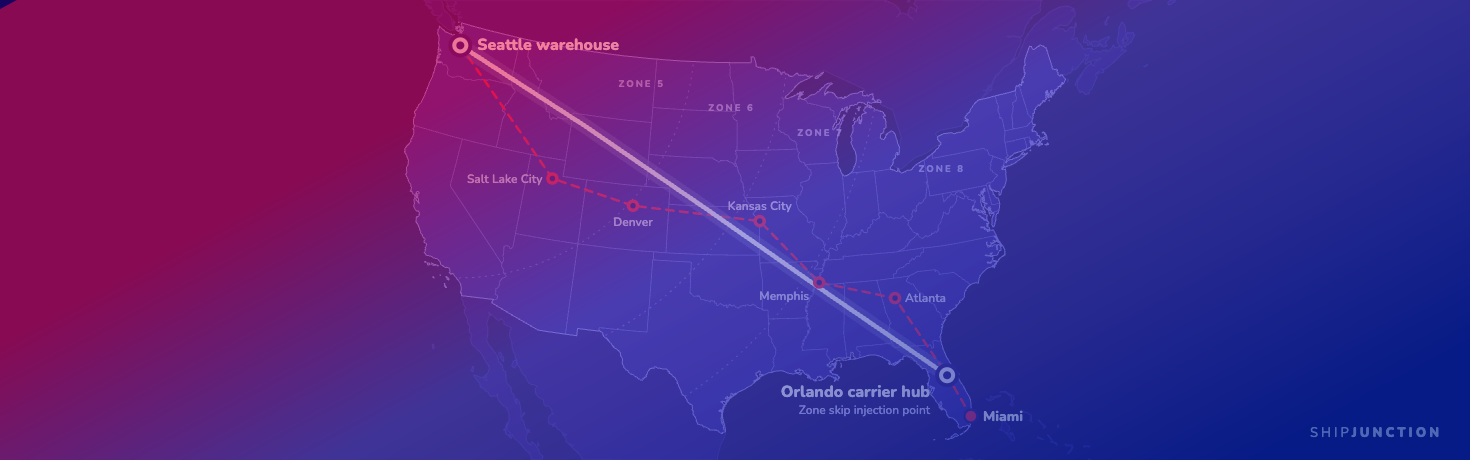
Zone Skipping Guide for Shippers: What Is It and How Does It Work
What Is Zone Skipping?
Zone skipping is a fulfillment strategy used to save on shipping costs for packages traveling long distances. Instead of having a single carrier ship packages the entire distance from your warehouse to the end customer, packages are aggregated and trucked in bulk to the carrier’s last-mile facility.
ShipJunction helps businesses integrate zone skipping directly into their existing shipping workflow. This article explains how it works, its benefits, and how ShipJunction makes it easier to execute without slowing down the warehouse.
How Does Zone Skipping Work?
Rather than shipping each parcel individually across multiple carrier zones, zone skipping moves orders over the long-haul leg as consolidated freight. Shippers group orders headed to the same region, truck them to a carrier hub near the delivery destinations, and inject the parcels there for last-mile delivery.
What It Requires:
- Group your parcels by region: Sort outbound orders by the region they’re headed to.
- Generate the shipping labels: Print the shipping labels for each package using the address of the last-mile carrier’s hub as the origin address.
- Truck orders: Load orders onto a truck (LTL or FTL) and transport them to the carrier hub. The packages are dropped off at the carrier facility, where parcels enter the carrier network.
- The last-mile carrier delivers orders: The carrier scans the packages into its network and completes last-mile delivery, typically within 1–2 days.
Zone skipping pays off once you have enough shipping volume to a single region. The threshold depends on the cost to ship the entire distance via parcel carrier versus the combined cost of trucking orders to a hub and shipping from there.
The Benefits of Zone Skipping
Save on shipping costs and improve margins
The cost to ship a package increases when shipping to higher zones. Zone skipping lets a business ship more packages rated for Zone 2 or 3 and take advantage of shorter distances and lower costs.
In our experience, it can produce savings between 15% and 30% per package, depending on the dimensional weight of each package.
Zone skipping also shrinks fuel surcharges, which are typically a percentage of the base rate and rise with distance.
For illustrative purposes, let’s assume shipping 1,000 orders the entire span from Los Angeles to Philadelphia, New York, and surrounding cities costs an average of $13 each, for a total carrier cost of $13,000. With zone skipping, you truck those orders to the New Jersey hub, where each package costs $7 to ship the last mile. After freight costs, there would be a 20% savings totaling $2,600.
Parcel-Only Shipping: 1,000 orders x $13 = $13,000
Zone Skip Shipping: ~$3,400 Freight + (1,000 orders x $7 parcel shipping) = $10,400
Total Savings = $2,600 (20% less shipping costs)
Greater Multi-Carrier Shipping Flexibility
Depending on your warehouse or distribution center location, certain carriers may not have a hub in your vicinity. You can take advantage of more favorable regional rates or different carrier networks by skipping zones and shipping orders from a closer carrier hub.
You would use it to move those packages closer to your customers and inject them at a carrier hub to take advantage of that network and get the added benefit of skipping zones.
Use Cases for Zone Skipping
- High-volume shipping to specific geographies: Shippers with a steady, predictable volume of orders going out to the same geographic region.
- Shipping subscription orders: Subscription orders are a great fit because you usually have a lot of lead time to prepare, consolidate, and ship orders out.
- Hazmat shipping: Many hazardous classes are restricted or prohibited from air transport, so ground is the only option regardless of distance. Zone skipping is a natural fit since they ship by ground anyway.
Why It’s Hard to Get Right
Zone skipping can be hard to execute because it involves several decisions and a lot of moving parts:
- Compiling rates from different origins to different delivery addresses
- Rating and printing shipping labels using a different origin address instead of your warehouse address
- Calculating freight costs to different carrier hubs
- Estimating total delivery times for each order
- Tracking orders across freight and parcel
Coordinating these types of decisions can feel overwhelming and consume a lot of time to setup and execute zone skipping. If origin addresses and labels aren’t set up correctly, mis-shipments and delays can cost more than it saves.
How ShipJunction Simplifies Zone Skipping
ShipJunction takes the complexity out of zone skipping by handling these decisions automatically inside your shipping workflow. You save on shipping costs without adding manual steps or risking poor customer experiences.
- Simple setup: Add a carrier hub as a zone-skip location, link it to one of your warehouses, and ShipJunction handles the rest.
- Automatic cost comparison: ShipJunction rates each shipment both ways, direct from your warehouse and from your zone-skip hub and then selects the lower-cost option.
- Correct labels every time: ShipJunction prints zone-skipped labels with the hub as the origin.
- Flexible freight pricing: Match your line-haul costs, whether by percentage markup, per package, or per pound.
- Accurate delivery dates: ShipJunction accounts for the time it takes to truck orders to the hub.
- Complete order tracking: Track zone-skipped orders alongside all other shipments.
If you want to learn more about zone skipping and how it would work for your specific operations. We would love to answer any additional questions you may have. Schedule a demo, contact us at [email protected] or call (415) 230-2185.